
Rupert Neve Designs Master Buss Processor
Based around the high voltage, discrete and class-A signal paths made famous in the 5088 Mixer, the Portico II Master Buss Processor is a creative tool that redefines the boundaries and limitations of traditional 2-channel compression and limiting. Though originally developed for mastering applications, the MBP quickly became a favorite of mix engineers, tracking engineers, and even FOH engineers. From mixing bass-heavy EDM to a delicate master of a chamber ensemble, it has something to offer everyone - no matter the use or genre.
With input and output transformers designed and implemented by Mr. Rupert Neve, the high-voltage 72V topology found in the Master Buss Processor will integrate flawlessly with virtually any system. Additionally, the MBP incorporates mastering-grade detented pots throughout to fine-tune its revolutionary dynamics, tone, and stereo field controls. This new topology is a significant evolution of Mr Rupert Neve's classic designs with appreciable benefits to headroom, dynamic range, distortion, noise, slew rate, bandwidth, and accuracy while still providing the sweet, musical performance that has been a part of countless recordings.
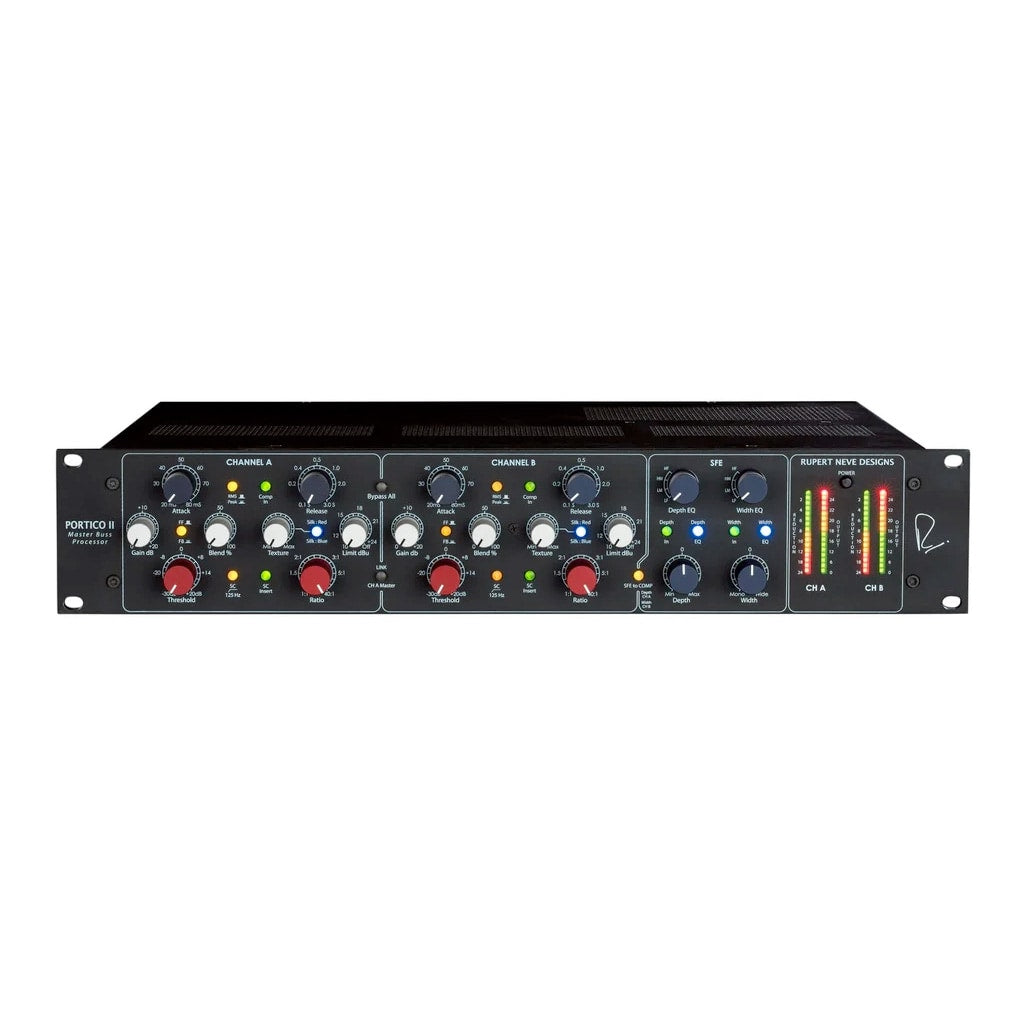
The MBP’s two compressor sections allow virtually limitless possibilities in dynamics for either dual mono or stereo sources, with controls for ratio, threshold, attack, release, blend, side chain HPF, limit and make up gain. When engaged, the compressor section can be used in both feed-forward and feed-back modes to provide a transparent “modern” response (feed-forward), or a smoother, more musical “vintage” response (feed-back). Peak mode alters the compressor’s attack to react to peak transients with a roughly .1ms response time. When the Peak switch is disengaged, the compressor responds to the RMS signal in conjunction with the attack and release settings.
SC HPF inserts a high pass filter at 125 Hz into the side chain to deal with intense low frequencies that may skew the response of the VCA with certain songs and instruments. And lastly, Blend creates a parallel mix between the compressed and dry signals. By mixing the compressed and dry signals, it is possible to increase the volume of quieter elements in the source material (for instance, delicate snare brushing on a track with much louder hits), while maintaining a natural dynamic feel for the louder elements.
The MBP also features an extremely versatile, transparent and musical limiter. At first glance, one might scoff at the single knob operation – however, this limiter is extremely intelligent, knowing how to appropriately respond to the various signals presented to it. Our new Adaptive Release Technology is behind this revolutionary performance. Using a blend of release time constants, this limiter will simultaneously respond quickly to transient material (such as the "snap" of a snare drum) and slowly to more sluggish signals (such as a bass guitar). This configuration allows the limiter to grab a transient and let go just an instant later, while also dealing with more constant signals in a slower, more musical way.
In this manner, the MBP's limiter can provide a much more aggressive amount of limiting than typically possible, while maintaining the essential character of the music and remaining free of the modulation distortion usually found in a fast-acting limiter. Additionally, the limiters share the same discrete, class-A gain module and VCA with the compressors, so using the Limiter does not introduce more stages that the music would have to pass through.
The stereo field editor on the MBP takes traditional M-S techniques to new heights with width, depth and corresponding bandpass filters.
The width control enables the user to increase or decrease the width of a stereo image (wide/mono) and adjust the amount of ambience inherent in the recording. As the width control is rotated toward wide, the amount of difference material is boosted, often resulting in more ambient material, and accentuated stereo reverbs. Conversely, the stereo field is contracted when rotated to mono, and, if the left and right channels are highly coherent (i.e. both channels include closely similar material that is in phase), this mono content is enhanced. The depth control adjusts the spatial positioning of elements in the sound stage. Center-panned elements like solo instrument or vocal can be brought forward in a mix, in relation to supporting instruments. In many cases, these same elements may be virtually eliminated without adversely affecting the music bed. Used in conjunction, the depth and width controls effectively alter the perceived room ambience and dimension.
To fine tune the SFE, there are individual filters that select what frequency information is reintroduced from the width and depth circuits, thus tailoring each effect to a specific bandwidth. And by engaging the SFE TO COMP button, Mid and Side signals can each be routed to the MBP’s two compressors, allowing the unit to operate in full M-S mode (as opposed to standard L-R operation).
Every mix deserves its own treatment. The Silk & Texture circuit allows you to fine-tune the amount (and type) of harmonic content in the output stage. This means your signal can be adjusted from extremely transparent to thick, weighty settings that produce several times the amount of sonic color found in Rupert's vintage modules - and in two very unique modes. No matter what sound you’re looking for, Silk will help get you there.
Drive the mix hard, choose your Silk flavor, and crank the Texture knob for a rich, saturated, vintage vibe - or disengage Silk entirely for clear, wide-open sonic beauty.
When you apply SILK RED, you're enhancing harmonic content generated by the highs and high mids of your source. This adds a sparkly sheen to the top end, and is often ideal for sources including vocals, snare, strings, pianos, and other acoustic instruments.
With SILK BLUE, you're enhancing harmonics generated by the lows and low mids of your source. This tends to "beef up" a signal from the bottom up, making it a great choice for drums, bass guitars, heavy electric guitars, male vocals, and synthesizers.
Product Overview
Product Specifications
Product Videos
Shipping Information
We provide free shipping on most items and Next Day delivery on all orders completed before 12pm (noon!) so you don’t have to pay extra or wait long to start enjoying your new equipment.
We use DPD to ship the majority of our orders within the UK. International locations will vary, learn more here.
Product Support
We work with some of the world’s leading audio manufacturers to provide everything from the trusted studio classics to modern, innovative technologies that help you to push sonic boundaries. We pride ourselves on offering the best support both before and after sale. If you have any questions, please get in touch.


Rupert Neve Designs Master Buss Processor
New Gear FAQs
Are all new items in stock?
With such a wide range of products we cant stock everything at all times.
The product page will display if an item is in stock. If it is marked as pre-order, you can place your order as normal and await its arrival into stock.
Please get in touch for an estimated shipping date. This may vary depending on stocking level with the manufacturer and/or distributor.
What warranty do you get with new gear?
Minimum 1 year manufacturer's warranty. Some manufacturers may also extend this (please see their respective websites for more information).
Can I part exchange used gear towards new gear?
Of course! Whether youre just looking to sell unused gear or looking to upgrade, get in touch here to discuss.
Can I test the equipment before I buy it?
We have a demo room at MNPA HQ where you are welcome to come and try out the equipment we have in stock. We’re not a shop and open to the general public so please get in touch via our Contact Form to book an appointment before coming to see us.